
Beginner Guides
Tarot for Self-Reflection: How to Use Cards Without Predicting the Future
A grounded guide to using tarot for self-reflection: notice, name, reframe, and choose without treating cards as predictions.
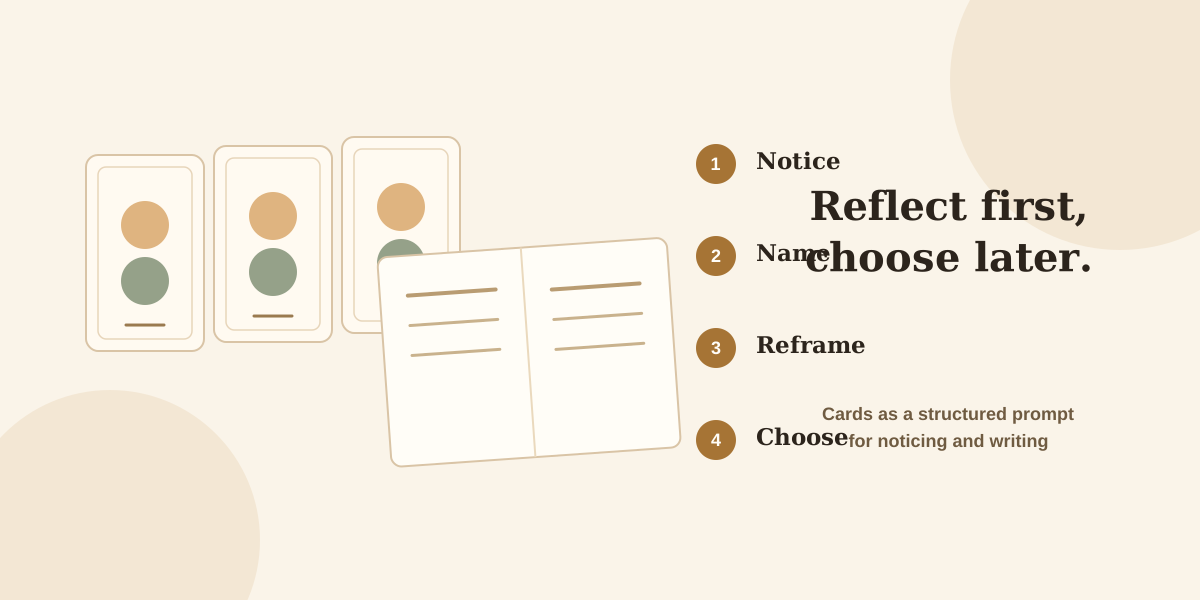
Tarot for self-reflection means using the cards as a structured prompt for attention, interpretation, and journaling. The value is not that the cards reveal a fixed future; it is that they give you a shape for noticing what is already true.
That distinction matters. A prediction-focused question asks what will happen. A reflection-focused question asks what you observe, what you assume, what you need, and what you can choose. Both can use the same deck. The difference is where you put the authority.
This guide walks through a four-step reflective practice, a complete example, and the questions that keep tarot useful without turning it into fortune telling.
What Does Tarot for Self-Reflection Mean?
Self-reflection tarot is a practice where the card is a mirror, not a message from fate. You draw a card, notice what it brings up, connect it to a real situation, and decide what deserves attention.
The card can suggest a theme: the Moon may point to uncertainty or intuition, the Two of Swords to a decision you are avoiding, the Four of Wands to stability. None of these are verdicts. They are lenses you can try on and set down.
This is why the same card can mean something different from one reading to another. The context comes from you: the question you asked, the week you had, the sentence you wrote in your journal.
How Tarot Can Work Without Predicting the Future
Tarot works as a reflective tool when you treat the reading as a conversation with yourself. The cards do not know what will happen next; they prompt you to look more carefully at what is happening now.
You can use a single card to check in, a spread to compare parts of a situation, and a saved history to notice patterns. That is still tarot. It just uses the deck as a thinking structure rather than a fortune-telling device.
If the language of a reading shifts you toward certainty, change the language. Ask what the card helps you notice instead of what it predicts. When a reading becomes more about your own interpretation than about the card, that is often where the useful work begins.
Prediction-focused
Will this relationship work out? What will happen at the new job? Is this person coming back?
Reflection-focused
What am I observing about this relationship? What do I need to know before deciding? What am I waiting for, and why?
The same cards can answer either kind of question. The reflection version keeps you as the person who interprets and chooses.
A Four-Step Reflection Framework
Keep the practice simple. Four moves are enough: Notice, Name, Reframe, Choose. Write each one down so the reading has a visible shape.
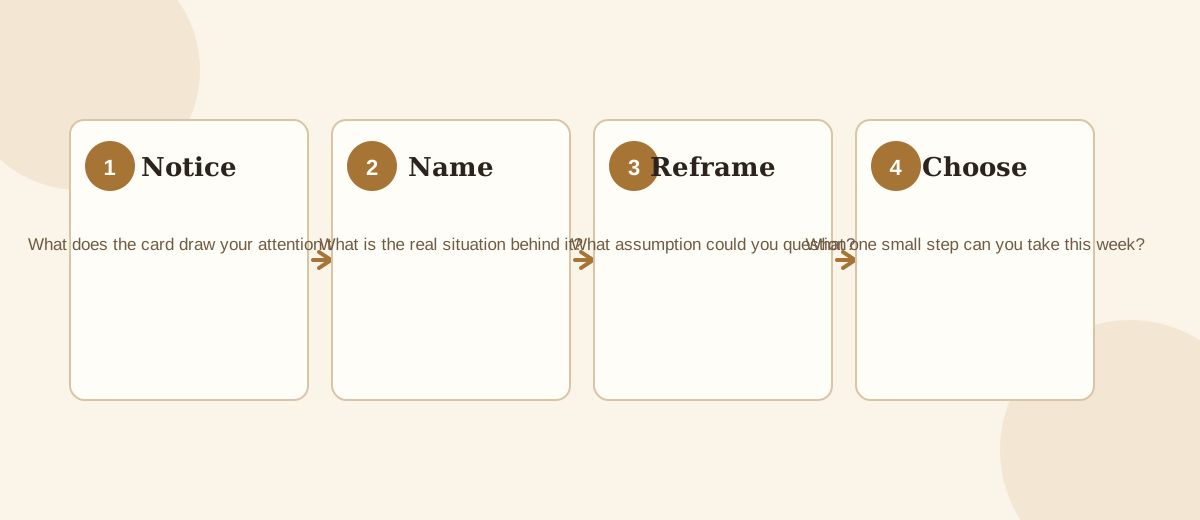
- Notice: What does the card draw your attention to? Describe it before interpreting it, including colors, figures, and what feels emphasized.
- Name: What is the real situation or feeling behind that image? Give it one plain sentence without drama or diagnosis.
- Reframe: What is another way to read the same situation? What are you assuming that could be checked or questioned?
- Choose: What is one small thing you can decide, say, ask, or try this week? Make it concrete enough to act on.
Use Fate Mirror as a private space to read, write, and notice what keeps returning.
A guided reading can organize what you notice; your journal keeps the context. Neither one hands your choices over to the cards.
Explore ReadingsExample: A Self-Reflection Reading
Suppose you have felt restless at work for a few months but cannot say why. You ask: "What is worth my attention right now?"
You draw the Five of Cups. Notice comes first: the card shows a figure looking at spilled cups while two cups remain standing. The image itself does not say "quit your job." It says something is being mourned while something else is still available.
Name it: "I have been focused on what the role has stopped giving me, and I have not looked closely at what still works." Reframe: "My frustration is real, but it is not proof that the whole situation is broken. What am I overlooking?" Choose: "This week I will write down two things I still value and two things I actually want to change, then decide which conversation comes next."
No card predicted the outcome. The reading gave you a structure for seeing your own situation more clearly.
Better Questions for Self-Reflection
A reflective question is open, self-relevant, and small enough to act on. It does not ask the cards to speak for another person or for the future.
Try versions like these: "What am I avoiding noticing?" "What do I need to protect this week?" "Which part of this decision is mine to make?" "What would I say if I were not afraid of the response?"
For relationship patterns, the Relationship Patterns reading can help you look at what keeps repeating. For a shorter daily anchor, the Daily Reading works with one card. The Card Meanings library gives you vocabulary, not verdicts.
What Tarot Cannot Decide for You
Tarot cannot verify another person's private thoughts, guarantee a future event, or tell you which choice is right. Anyone who promises otherwise is asking you to give away the part of the practice that belongs to you.
It also cannot replace a conversation, a safety plan, or professional support. If you are deciding whether to leave a relationship, change careers, or manage a health concern, use tarot as a way to clarify your own reasoning, not as the final authority.
When a card seems to say something uncomfortable, you can still disagree with it. You can ask why it felt significant, then set it down. That freedom is what keeps the practice reflective.
How Journaling Changes the Practice
A reading without notes is easy to rewrite. Days later, you may remember only the part that fit your mood. Journaling keeps the original question, the cards, and your reaction together, so you can compare them honestly.
Over time, the pattern is usually more useful than any single card. The same question returning, the same feeling showing up after different draws, the gap between what you wrote and what you now believe: those are the places where reflection actually happens.
Save the context with each reading, not just the card name. If you are using Fate Mirror, your saved readings and Journal can stay in one private space, and the Weekly Mirror can help you compare recurring themes in context instead of treating repetition as a sign.
Clarity, Not Certainty
Fate Mirror's position is simple: the cards can give you structure, and you give them meaning. The practice is private, reflective, and continuous. One reading captures a moment; a history shows what keeps returning.
You do not need to believe in prediction to use tarot well. You only need a question, a card, and the willingness to write down what you notice.
Use Fate Mirror as a private space to read, write, and notice what keeps returning.
A guided reading can organize what you notice; your journal keeps the context. Neither one hands your choices over to the cards.
Explore ReadingsFAQ
Can tarot be used without fortune-telling?
Yes. Treat the cards as prompts for noticing and journaling, not as sources of future facts. The value comes from your interpretation and the questions you bring.
Is tarot useful for journaling?
Very. A card gives a daily entry a focal point, and a saved history gives you a way to compare questions, moods, and patterns over time.
Can tarot make decisions for me?
No. Tarot can help you organize what you observe, what you need, and what you are assuming, but the choice remains yours.
How is reflective tarot different from prediction?
Prediction asks what will happen and places authority in the cards. Reflection asks what you notice and places authority with you.
The best reading you do may be the one that helps you say something true about your own life. Keep the cards as a mirror, and keep the pen in your hand.