
Card Meanings
Upright vs. Reversed Tarot Cards: A Beginner’s Guide
A practical beginner’s guide to understanding upright and reversed tarot cards without treating reversals as automatic bad news or fixed opposites.
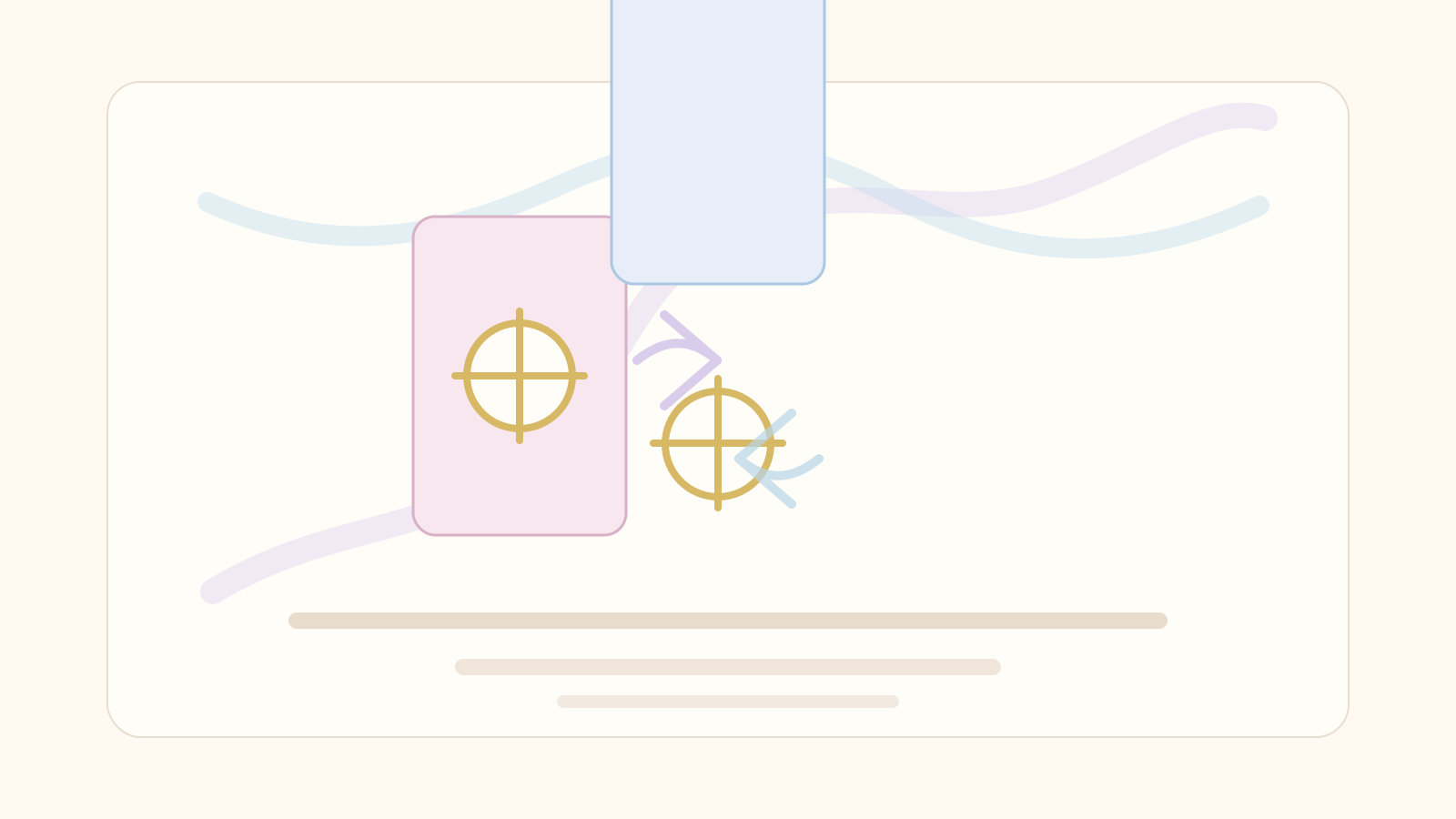
The difference between upright and reversed tarot cards is not as simple as “good” and “bad.” Upright cards often show a card’s theme in a more direct, visible, active, or outward form. Reversed cards may show the same theme as blocked, delayed, internalized, uneven, excessive, avoided, or ready to be reconsidered.
A reversed meaning is not always the exact opposite of the upright meaning. A reversed card is not automatically a “bad card.” Reading reversals is optional. Many careful readers use reversals; many careful readers do not. The useful question is not whether the card is upside down by itself, but how the card’s core theme is behaving in the question, the spread position, the surrounding cards, and the real situation in front of you.
That distinction matters because tarot reversals can easily become a source of fear. If every upside-down card is treated as failure, rejection, betrayal, or disaster, the reading stops being useful. A better approach keeps the card’s original theme intact and asks how that theme is being expressed.
What Is an Upright Tarot Card?
A tarot card is upright when it appears in its standard orientation, facing the reader the way the deck artwork is normally shown. In many readings, the upright orientation suggests that the card’s central theme is more visible, available, direct, or active.
Upright does not automatically mean positive. Some upright cards speak about grief, endings, tension, hard choices, conflict, uncertainty, or necessary limits. A card connected with communication may appear upright when a conversation is active or ready to happen. That does not mean the conversation will be comfortable, successful, or easy to receive.
Orientation alone cannot determine the result. An upright card gives you a cleaner view of the theme, but the tone still depends on the question, spread position, nearby cards, and what is actually happening.
What Is a Reversed Tarot Card?
A reversed tarot card appears upside down relative to the reader. It still belongs to the same card family and usually keeps a clear connection to the card’s core meaning. What changes is how that meaning is expressed, noticed, resisted, or acted upon.
A reversed card may point to resistance, delay, internalized energy, imbalance, a muted expression, an exaggerated expression, avoidance, misalignment, a need to reconsider, or a different perspective. These are reading frameworks, not fixed formulas.
Reversed does not mean that the upright meaning should simply be replaced with its opposite. That shortcut is tempting because it feels tidy. It often makes the reading less accurate, because symbols rarely work as clean switches.
Upright vs. Reversed Tarot: A Quick Comparison
A quick comparison helps, as long as it does not become a rigid rule. Think of orientation as a lens on the card’s theme, not as a verdict.
Upright
More direct, visible, active, or outward expression of the card’s theme.
Reversed
More blocked, delayed, internal, uneven, exaggerated, or reconsidered expression of the same theme.
Upright
The energy may be easier to recognize, but it does not always mean positive, easy, or yes.
Reversed
The energy may be harder to express clearly, but it does not always mean negative, failed, or no.
Both
Both orientations depend on the question, spread position, surrounding cards, and real-life context.
Explore a guided reading with more context
Use a private reading to notice the question, card position, and real-life details before turning a card into a conclusion.
Browse Guided ReadingsSix Ways to Read a Reversed Tarot Card
The most useful reversed tarot card meanings usually come from one or two clear observations, not from listing every possible interpretation. Start with the card’s core theme, then choose the framework that actually fits the situation.
Resistance
The theme is present but difficult to express. Someone may want a conversation but keep avoiding it, feel motivated but struggle to begin, or know a boundary is needed but hesitate to state it. Resistance can come from inner fear or real conditions; it is not proof of personal failure.
Delay
Something may still be developing more slowly than expected: a postponed conversation, a decision needing preparation, limited time or resources, or an idea not ready for action. Delay is not permanent failure.
Internalization
The card’s energy may be happening privately rather than outwardly: emotional processing, unspoken frustration, quiet doubt, motivation not yet acted on, or a decision being considered but not discussed.
Imbalance
The energy may be too little, too much, or used in the wrong way: too much control, too little rest, overthinking, suppressed emotion, action before planning, or stability that ignores exhaustion.
Exaggeration
Sometimes the issue is not absence but distortion. Confidence becomes impulsiveness, care becomes overinvolvement, planning becomes paralysis, independence becomes isolation, and discipline becomes rigidity.
Reconsideration
The reversal may ask for a pause: What am I overlooking? Where might I need a different approach? Is this energy being expressed clearly? What would a healthier expression of this card look like?
Are Reversed Tarot Cards Always Negative?
No. A reversal may show that a difficult pattern is losing strength. It may point to private healing, growing awareness, or the moment when someone notices an approach that is no longer helping. It may reveal an opportunity to slow down and correct an imbalance before it becomes more costly.
This does not mean reversals are secretly always positive. Some reversed cards can describe avoidance, confusion, strain, or a pattern that has become hard to express honestly. The point is narrower and more useful: positive versus negative is often too simple for a complex situation.
Some upright cards carry difficult themes. Some reversed cards can show relief or release. The orientation gives you a clue about expression, not a moral label.
Do Reversed Cards Mean the Opposite?
Sometimes an opposite interpretation fits. A card about openness may, in a particular spread position, suggest guardedness when reversed. But exact opposites should not be the automatic default. They can flatten the card’s symbolism and make the reading sound more certain than it is.
A more reliable method is to preserve the core theme and ask how its expression has changed. Take a card connected with action and motivation. Upright, the energy may be moving outward: a person is ready to begin, act, or make progress. Reversed, the same motivation may be blocked, scattered, delayed, internalized, excessive, or pointed at the wrong priority.
Both interpretations come from the same theme. The reversal changes the condition of the energy; it does not erase the card and replace it with a different card.
A Simple Three-Step Method for Reading Reversals
Beginners often get stuck because they try to memorize a separate reversed meaning for every card. A simpler method is usually more accurate.
1. Core theme
Ignore orientation for a moment. Name the card’s basic theme: communication, motivation, emotional connection, stability, change, boundaries, responsibility, rest, or another clear idea.
2. Changed expression
Ask how the theme is behaving. Is it blocked, delayed, internalized, imbalanced, excessive, avoided, muted, or being reconsidered? Choose the one or two options that fit best.
3. Real-life context
Bring the meaning back to the question. Where is it showing up? Is it internal or external? What makes it hard to express? What practical next step would make the reading useful?
Example: Reading the Same Theme Upright and Reversed
Suppose a card in a reading points to communication. Upright, the need for a conversation may be visible. An issue might be ready to be discussed, clarified, or put into words. That still does not predict that the conversation will go perfectly; it only shows that the theme is active and available.
Reversed, the same communication theme may be delayed, avoided, misunderstood, or taking place mostly inside someone’s thoughts rather than in the open. A person may be drafting the email and not sending it. A team may keep postponing the meeting. A boundary may be clear internally but not yet stated.
Neither orientation predicts exactly what will happen. They describe different expressions of the same theme. A second example works with motivation: upright can show energy moving toward action; reversed can show enthusiasm scattered across too many priorities or a project that needs grounding before it can begin.
Do Beginners Have to Use Reversed Tarot Cards?
No. Reading reversals is optional. Some readers use both upright and reversed cards. Others keep every card upright and still consider constructive, difficult, internal, delayed, and excessive expressions of the same card. Neither method is automatically more accurate.
More complexity does not always produce better interpretation. Beginners can start with upright cards, learn the core meanings, and add reversals later if the extra layer helps. Consistency matters. Clear reasoning matters. A reader who can explain why an interpretation fits the question will usually produce a better reading than a reader who uses reversals mechanically.
How to Start Practicing Reversed Cards
Use one card before using a large spread. Write down the card’s core theme, turn it upside down, and consider only the frameworks that match the question. Then write one useful prompt rather than a final prediction.
- Choose one card, not a full spread.
- Write the core theme before thinking about orientation.
- Ask what feels blocked, delayed, internalized, imbalanced, exaggerated, or ready to reconsider.
- Select only the interpretation that fits the question and real situation.
- Use a light journal template: Core theme; what feels difficult to express; what may be delayed; where the energy is out of balance; what deserves another look; one practical next step.
- Review the note later as an observation, not as a fixed prediction.
Common Beginner Mistakes
The first mistake is treating every reversal as bad news. That habit creates fear quickly, especially in relationship readings, and it usually reduces clarity. A reversed card may describe a difficulty, but it does not prove disaster.
The second mistake is automatically using the exact opposite meaning. It is simple, but often too crude. A reversed card should still grow from the card’s original meaning. If you ignore the original symbol, the reading becomes a guessing game.
Another mistake is reading without context. A reversal in a “what needs attention” position is not the same as a reversal in an “external obstacle” position. Surrounding cards, the question, and the real situation all change the interpretation.
Beginners also tend to list too many possible meanings at once. If you write down eight interpretations, you may feel thorough while losing judgment. Choose the one or two that are supported by the question. And avoid absolute claims about another person. A reversed card does not prove that someone is lying, betraying you, hiding a diagnosis, or acting with bad intent.
Upright and Reversed Meanings Can Coexist
Real experiences are rarely binary. Someone may be taking action outwardly while feeling uncertain internally. A conversation may be happening, but the most important point remains unspoken. A job may look stable while motivation is steadily declining. A relationship may contain genuine connection alongside weak boundaries.
This is why upright vs reversed tarot works best as a spectrum of expression, not as two mutually exclusive answers. Orientation can help you notice whether a theme is visible, hidden, active, delayed, balanced, distorted, or ready for a different approach.
Final Thoughts
Upright cards often show a more direct expression of a theme. Reversed cards may show resistance, delay, internalization, imbalance, exaggeration, or reconsideration. They are not automatically negative, and beginners do not have to use them.
A reversed card becomes useful when it helps name what is difficult to express, slower to develop, or ready to be reconsidered. It becomes less useful when it is treated as automatic bad news. Context and honest observation matter more than fixed formulas. Use the card as a prompt for your next journal entry, then return to the real choices in front of you.
Explore a guided reading with more context
Use a private reading to notice the question, card position, and real-life details before turning a card into a conclusion.
Browse Guided ReadingsFAQ
What is the difference between upright and reversed tarot cards?
Upright cards often show a card’s theme in a more direct, visible, or outward form. Reversed cards may show the same theme as blocked, delayed, internalized, imbalanced, or ready to be reconsidered. Both need context: the question, spread position, surrounding cards, and real-life situation.
Are reversed tarot cards bad?
No. A reversed card is not automatically negative. It can describe difficulty, but it may also show awareness, adjustment, release, private processing, or a chance to correct an imbalance. The card’s orientation is a clue, not a verdict.
Do reversed tarot cards always mean the opposite?
Not always. Sometimes an opposite meaning fits, but it should not be the default. A stronger method is to keep the card’s core theme and ask whether that theme is blocked, delayed, excessive, internal, avoided, or expressed in a different way.
How do beginners read reversed tarot cards?
Start with three steps: identify the card’s core theme, ask how that theme is blocked, delayed, internalized, or imbalanced, and connect the interpretation back to the actual question. Do not make a major conclusion just because a card is upside down.
Do I have to use reversed tarot cards?
No. Reading reversals is a choice. Some readers use them; others keep every card upright and still consider difficult or internal expressions. Consistency and clear reasoning matter more than using every possible technique.
Can an upright card have a negative meaning?
Yes. Upright does not automatically mean positive, successful, or yes. Some upright cards relate to grief, conflict, endings, uncertainty, limits, or difficult choices. Reversed does not automatically mean negative either.